On this page: Hinduism — Parents: Fotografische Themen › Kultur › Religionen — Photography, Technology & Science at the Tenckhoff Photo Archive.
Hinduism is one of the world’s oldest living religions, tracing its roots back to the Vedic period around 1500 BCE. Unlike monotheistic traditions, Hinduism has no single founder, central dogma, or unified scripture, but rather a vast network of teachings, myths, and rituals that have evolved over millennia. At its core lies the concept of Brahman, the all-pervading, eternal reality underlying all existence. The individual self, Atman, is considered an expression of this divine whole. Humanity’s spiritual task is to realize the unity of Atman and Brahman – an insight achieved through meditation, knowledge, and ethical living.
Karma, Dharma, and Samsara form the central pillars of Hindu cosmology. Karma refers to the law of cause and effect, Dharma to the moral and cosmic order, and Samsara to the cycle of birth, death, and rebirth. The ultimate goal is Moksha, liberation from this cycle and the realization of unity with Brahman.
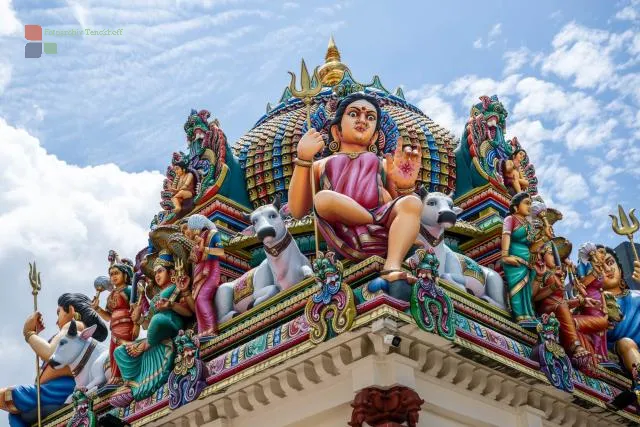
Within the framework of the Quantum Monad Theory, Hinduism can be seen as an early intuitive expression of universal entanglement: everything is an emanation of a higher cosmic field that manifests in countless forms while remaining ontologically one. The multiplicity of deities mirrors the diversity of expressions within the quantum field, where infinite states coexist within one underlying reality.
In contemporary times, Hinduism demonstrates remarkable adaptability. Practices such as Yoga and meditation, once purely spiritual disciplines, have become global methods of self-reflection and inner balance. Thus, Hinduism continues to act as a bridge between ancient insight and modern consciousness, resonating with the human quest for unity and transcendence.