In this article: When Decentralization Depends on the Cloud – What the AWS Outage Revealed About NFTs
Introduction
When Amazon Web Services experienced a large-scale outage on October 23, 2025, millions of digital images disappeared for hours – including those of numerous NFTs on the Ethereum network. Marketplaces displayed placeholders. The blockchain kept running, yet the images were gone.
The incident also made it clear that there is a widespread misconception: NFTs are not the artwork itself. They are usually certificates – ownership proofs or references to a work that exists outside the blockchain. What they certify may stand as a sculpture in a showcase, a house on an estate, or as a digital image on a server, in a cloud (such as AWS), or within the IPFS. Only in the interplay between blockchain and storage location does what we perceive as “NFT art” truly emerge.
A notable exception are the so-called Bitcoin Ordinals. In their case, the artwork itself – for instance an image or text – is written directly into the Bitcoin blockchain. It exists on-chain, becoming a permanent part of the ledger, independent of external services or cloud providers. The downside: this approach is technically demanding and expensive.
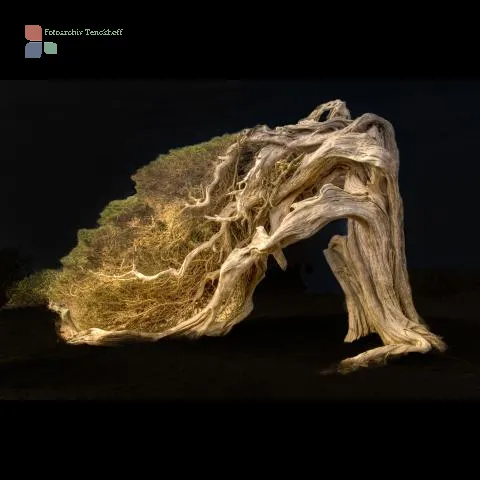
Real independence from centralized servers or corporate cloud providers, however, can only be achieved through the InterPlanetary File System (IPFS). Files are stored decentrally and addressed by their cryptographic fingerprint (Content Identifier, CID). If one server fails, other nodes deliver the data. An example is the NFT “Juniper tree on El Hierro”, whose metadata and image remain permanently available via IPFS – even if a major cloud provider goes offline.
Ownership Is Not the Image
An NFT on Ethereum usually contains no image data but a reference. The smart contract stores a tokenURI pointing to a metadata file:
tokenURI(1234) → ipfs://QmZx9abc1234/1234.json
The JSON file includes, for example, title, description, and a link to the image:
{
  "name": "Sunset in Tasmania",
  "description": "Light, colour and structure in balance with the whole.",
  "image": "ipfs://QmTnK8.../image.webp"
}
If the external storage (for instance, a cloud bucket) fails, the ownership record remains intact – but the image disappears. The NFT still exists, yet it loses its visible form.
Practical Examples
Own example (Ethereum, decentralized via IPFS):
The NFT “Juniper tree on El Hierro” illustrates how proper linking works. Its tokenURI points to metadata stored permanently on IPFS:
ipfs://QmRMU7C9KCmNxshUChSd1W4ULsGbiF4NX79yCNLyVMFAz2/metadata.json
The JSON entry contains:"name": "Juniper tree on El Hierro""description": "A juniper tree bent by the wind on El Hierro, the little Canary Island""image": "ipfs://QmcezqRbCiqAwZs3suZXYLUhA3UybM2fHs5duwNx1jkchY/nft.jpg"
Opening the image CID through a public gateway such as https://ipfs.io/ipfs/QmcezqRbCiqAwZs3suZXYLUhA3UybM2fHs5duwNx1jkchY/nft.jpg displays the artwork itself – independent of centralized cloud services.
Variant 2 (centralized web server):
Some projects use a simple URL such as https://example.com/meta/1234.json. This is convenient but depends on a single web server or domain.
Variant 3 (Arweave / IPFS best practice):
Modern NFT contracts use hash-based addresses such as ipfs://… or ar://…. This ensures the content is cryptographically bound to the address – any change alters the CID and becomes immediately visible.
Four Models of NFT Structure
| Blockchain | Data Storage | Location | Characteristic |
|---|---|---|---|
| Ethereum | Off-chain metadata (tokenURI) | IPFS / Arweave / AWS | Ownership points to content |
| Bitcoin (Ordinals) | Fully on-chain | Within Bitcoin blocks | Ownership and content are one |
| Cardano (CIP-25/68) | Metadata in UTXO + IPFS CID | Cardano + IPFS | Meaningful fields (title, artist, description) embedded directly in the transaction structure |
| Solana (Metaplex) | Off-chain metadata account | Arweave / IPFS | Fast and scalable, less durable |
Glossary
NFT (Non-Fungible Token)
Unique digital proof of ownership on a blockchain.
Blockchain
Decentralized, tamper-proof database for transactions.
Smart Contract
Program code on the blockchain executing predefined rules automatically.
tokenURI
Link to an NFT’s metadata file (usually JSON, containing the image reference).
IPFS (InterPlanetary File System)
Decentralized network for persistent file storage, addressing content by its CID (hash).
Arweave
Blockchain-based long-term data storage network.
AWS (Amazon Web Services)
Major cloud provider; frequently used to host NFT metadata or images.
on-chain
Data stored directly within the blockchain.
off-chain
Data stored outside the blockchain, referenced by a link.
CIP-25 / CIP-68
Cardano standards for NFT metadata and extended functionality.
UTXO (Unspent Transaction Output)
The transaction model used by Bitcoin and Cardano. Each transaction uses previously received amounts (technically called inputs) and creates new ones (outputs). Only the outputs that have not yet been spent are considered UTXOs – they represent the actual available balance. Unlike account-based models (e.g. Ethereum), all values are tracked individually rather than as a single account balance.
Example: You receive 1 BTC – this is a UTXO (a kind of “coin”). When you spend 0.4 BTC, that UTXO is consumed and two new ones are created: one worth 0.4 BTC sent to the recipient, and one worth 0.6 BTC returned to you as “change.” This way, every movement of value remains precisely traceable.
In Ethereum, by contrast, an account model is used: You receive 1 Ether, and your account balance simply increases by one. A transaction then adds to or subtracts from this balance — there are no individual “coins,” only the current total amount.